Xernix
A privacy-first, CPU-mineable mainnet blockchain forked from Monero v0.18.3.4 — with its own genesis block, coin (XNX), and independent network identity.
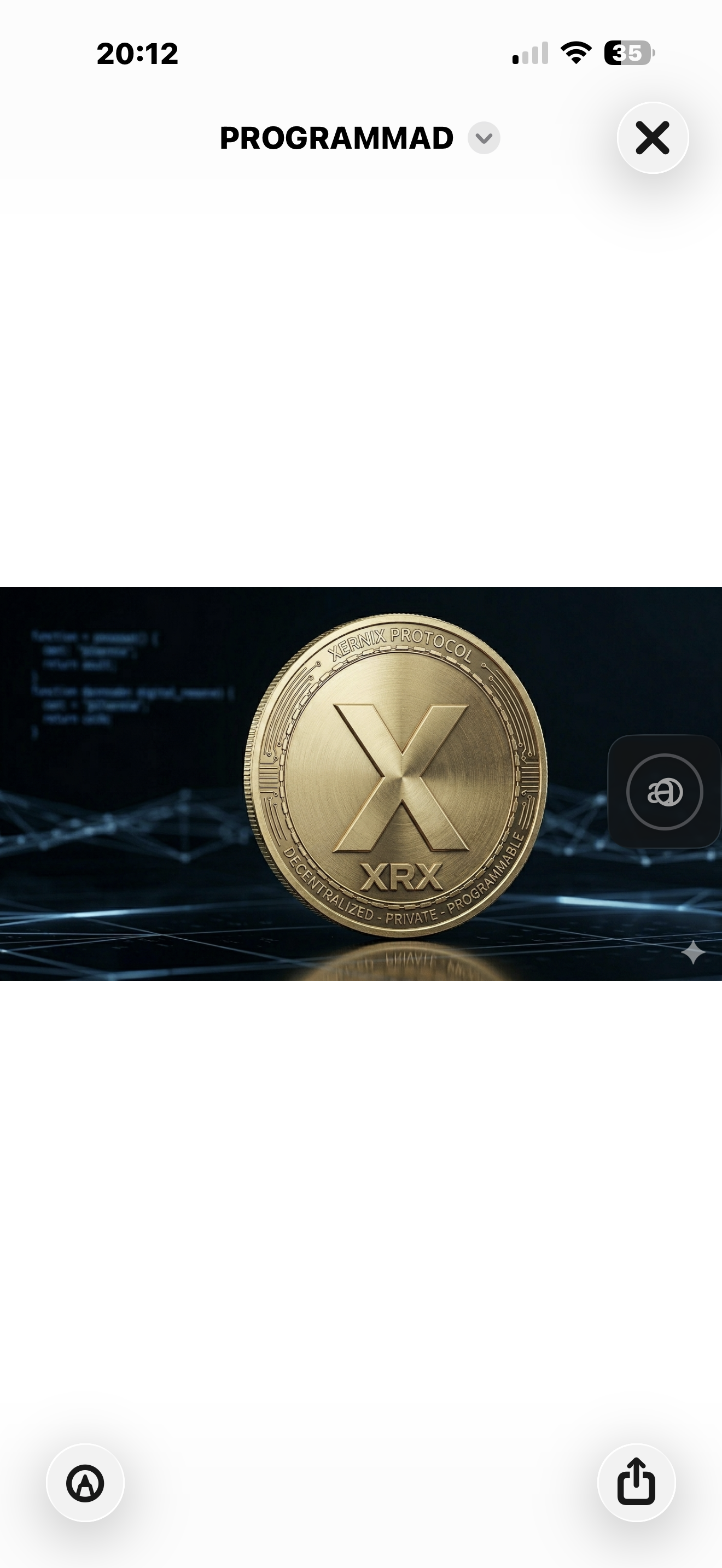
Overview
Xernix is a standalone mainnet blockchain built on the proven foundation of Monero v0.18.3.4. It ships with a fresh genesis block, its own native currency XNX, and a custom network identity — fully independent from Monero, Testnet, or any other existing chain.
Xernix inherits Monero's core privacy primitives — ring signatures, stealth addresses, and RingCT (Ring Confidential Transactions) — ensuring that every transaction is private and untraceable by default. The RandomX proof-of-work algorithm makes the network ASIC-resistant, keeping mining accessible to anyone with a standard CPU.
The total supply of XNX is hard-capped at 21,000,000 XNX — mirroring Bitcoin's famous limit — making it a deliberately scarce, privacy-first asset. Of this total, 18,900,000 XNX (90%) are distributed through open CPU mining, and 2,100,000 XNX (10%) constitute a locked founder's reserve released in transparent tranches: 100,000 XNX at genesis, then 200,000 XNX every 10 years.
This document describes the technical architecture, cryptographic primitives, network parameters, tokenomics, and public API of the Xernix mainnet.
Introduction
Bitcoin introduced the concept of a decentralized ledger in 2009. However, Bitcoin's transparent ledger — where every transaction is publicly visible — creates significant privacy risks for users. Monero solved this with cryptographic privacy primitives that make transactions unlinkable and untraceable.
Xernix takes this a step further by launching a completely fresh chain — not a token or a sidechain, but an independent Layer-1 blockchain — with its own genesis block, its own coin supply, and its own network identity. This gives participants a clean slate: no pre-mine, no ICO, no early-mover advantage beyond CPU power.
1.1 Motivation
Existing privacy coins carry years of chain history, entrenched mining pools, and accumulated wealth concentrations. Xernix starts from block zero, making it the only chain where all XNX in existence was mined fairly after genesis.
The Xernix network is designed to be lightweight enough to run on modest hardware (including cloud VMs), while still providing the full cryptographic guarantees of the Monero protocol.
Architecture
Xernix is a fork of Monero v0.18.3.4 (Fluorine Fermi), compiled
from source with three custom patches applied. The daemon binary is xernixd
and stores its data in ~/.xernix/.
2.1 Consensus — RandomX Proof of Work
Xernix uses the RandomX proof-of-work algorithm, designed specifically to be CPU-friendly and ASIC-resistant. RandomX executes random programs in a virtual machine with large memory requirements (~2 GB for full mode), making it impractical to build specialized hardware.
The target block time is 60 seconds. Difficulty adjusts automatically every block using Monero's LWMA (Linearly Weighted Moving Average) algorithm, ensuring stable block times regardless of hash rate fluctuations.
| Parameter | Value | Notes |
|---|---|---|
| Algorithm | RandomX | CPU-optimized PoW |
| Block time target | 60 seconds | LWMA difficulty adjustment |
| Block size limit | Dynamic | Median-based penalty system |
| Finality | ~10 minutes | Probabilistic (10 blocks) |
| Lock period | 60 blocks | Coinbase outputs locked for 60 blocks |
2.2 Privacy Primitives
Every Xernix transaction is private by default using three complementary techniques:
| Technique | What it hides |
|---|---|
| Ring Signatures | The sender — your key is mixed with a ring of other public keys, making it impossible to determine who signed the transaction |
| Stealth Addresses | The recipient — each transaction creates a one-time address derived from the recipient's public key; only the recipient can find it |
| RingCT | The amount — transaction amounts are hidden using Pedersen commitments and range proofs; only sender and recipient know the value |
Network Identity
Xernix uses a unique network identity that is cryptographically incompatible with Monero, Monero testnet, or any other Cryptonote-based chain. Nodes identify each other by a fixed 16-byte UUID embedded at compile time.
| Field | Value |
|---|---|
| Network Name | xernix-mainnet |
| Network UUID | ASCII "xernix-main-net" (16 bytes) |
| Data Directory | ~/.xernix/ |
| P2P Port | 18080 |
| RPC Port | 28081 |
| ZMQ Port | 28082 |
| Wallet RPC Port | 28083 |
3.1 Genesis Block
The Xernix genesis block was mined with a custom nonce of 21,000,000 (a nod to Bitcoin's fixed supply). The genesis coinbase transaction establishes the very first XNX in existence. No coins existed before block 1.
3.2 Address Format
Xernix uses a custom address prefix of 180 in decimal, which encodes
to [0xB4, 0x01] as a two-byte varint — causing all addresses to start
with the letter X. Addresses are 97 characters long (Base58-encoded
70-byte payload).
| Address Type | Prefix | Varint | Length |
|---|---|---|---|
| Standard | 180 | [0xB4, 0x01] | 97 chars |
| Subaddress | 181 | [0xB5, 0x01] | 97 chars |
| Integrated | 182 | [0xB6, 0x01] | 108 chars |
Example Xernix address (official wallet):
Tokenomics
4.1 Emission Curve — Mining Supply
Xernix has a hard cap of 21,000,000 XNX — identical to Bitcoin's maximum supply — making XNX a scarce, privacy-first digital asset. Of this total, 18,900,000 XNX are distributed through open CPU mining using a smooth decreasing block reward, starting at roughly ~17.6 XNX per block and declining over time.
A permanent tail emission of 0.6 XNX per block is enforced after the main emission phase, ensuring miners are always compensated to secure the chain.
| Parameter | Value |
|---|---|
| Total supply cap | 21,000,000 XNX |
| Public mining supply | 18,900,000 XNX (90%) |
| Founder's reserve | 2,100,000 XNX (10% — see §4.2) |
| Initial block reward | ~17.6 XNX |
| Emission formula | reward = (M - A) × 2⁻²⁰ × 10⁻¹² |
| M (supply cap in atomic units) | 21,000,000 × 10¹² |
| Tail emission | 0.6 XNX / block (permanent) |
| Tail emission starts | ~Block 5,256,000 (est. ~10 years) |
| Decimal places | 12 (piconero precision) |
4.2 Founder's Reserve — 2,100,000 XNX (Protocol-Locked)
10% of the total supply — exactly 2,100,000 XNX — is held in a dedicated reserve wallet whose spend key is not held by anyone, including the founder. The coins are cryptographically inaccessible until each tranche's scheduled date, at which point a new wallet is generated for that specific release only.
This is not a promise — it is a technical guarantee: without the spend key, no one can move these coins. The reserve wallet address is public and can be monitored by anyone at any time on the block explorer.
| Tranche | Amount | Release Date | Status |
|---|---|---|---|
| Genesis (Tranche 0) | 100,000 XNX | Launch — May 2026 | ✓ Unlocked |
| Tranche 1 | 200,000 XNX | 2036 | 🔒 Locked |
| Tranche 2 | 200,000 XNX | 2046 | 🔒 Locked |
| Tranche 3 | 200,000 XNX | 2056 | 🔒 Locked |
| Tranche 4 | 200,000 XNX | 2066 | 🔒 Locked |
| Tranche 5 | 200,000 XNX | 2076 | 🔒 Locked |
| Tranche 6 | 200,000 XNX | 2086 | 🔒 Locked |
| Tranche 7 | 200,000 XNX | 2096 | 🔒 Locked |
| Tranche 8 | 200,000 XNX | 2106 | 🔒 Locked |
| Tranche 9 | 200,000 XNX | 2116 | 🔒 Locked |
| Tranche 10 | 200,000 XNX | 2126 | 🔒 Locked |
| Total | 2,100,000 XNX | 2026 → 2126 | 10% of supply |
4.3 Deflationary Burn — 1.5% Transaction-Based Destruction
Every outgoing XNX transaction automatically redirects 1.5% of the transferred
amount to a provably unspendable burn address. This coin destruction is
enforced at the wallet layer: the official Xernix wallet appends a burn output to
every transfer call before broadcasting the transaction.
The burn address was generated using a Nothing-Up-My-Sleeve (NUMS)
construction — a try-and-increment hash-to-curve algorithm seeded with the public
string "xernix-burn-mainnet-v1-spend". The resulting Ed25519 point has
no known corresponding private scalar: nobody, including the project
creator, can spend coins sent to this address. The derivation is fully reproducible
and publicly auditable.
| Parameter | Value |
|---|---|
| Burn rate | 1.5% of transfer amount (15 permille) |
| Formula | burn = floor(amount × 15 / 1000) |
| Enforcement layer | Wallet layer (official client) · Consensus-layer hard fork planned |
| Burn address type | NUMS — provably unspendable, no private key |
| NUMS seed string | xernix-burn-mainnet-v1-spend |
| Bypass possible? | Only with a custom (non-official) wallet — hard fork will close this |
TX_EXTRA_TAG_BURN validation directly into the daemon — after
which every node on the network will reject any transaction that omits the 1.5% burn
output, making bypass impossible regardless of which wallet software is used.
4.4 Transaction Fees
Fees on Xernix are dynamic and market-driven. The minimum fee is set by the daemon based on block utilization. Fees are paid to the block miner, providing a long-term incentive beyond the block reward.
| Fee Type | Value |
|---|---|
| Minimum fee | 0.000002 XNX (2 × 10⁹ piconero) |
| Fee unit | piconero (10⁻¹² XNX) |
| Fee recipient | Block miner |
| Fee algorithm | Dynamic — based on transaction weight |
Cryptography
Xernix uses the same cryptographic primitives as Monero v0.18 — all based on established, peer-reviewed algorithms.
5.1 Key Generation
A Xernix wallet consists of two ed25519 keypairs: a spend keypair and a view keypair. The spend key authorizes outgoing transactions; the view key allows scanning the blockchain for incoming transactions without the ability to spend funds.
| Component | Algorithm | Size |
|---|---|---|
| Private spend key | Random 256-bit scalar (reduced mod ℓ) | 32 bytes |
| Private view key | Keccak-256(spend key) mod ℓ | 32 bytes |
| Public spend key | spend_key × G (ed25519 basepoint) | 32 bytes |
| Public view key | view_key × G | 32 bytes |
| Address checksum | Keccak-256(prefix ‖ pubkeys)[0:4] | 4 bytes |
| Address encoding | Base58 (Monero variant) | 97 chars |
5.2 Ring Signatures
Each transaction input is signed using a MLSAG (Multilayered Linkable Spontaneous Anonymous Group) ring signature. The signer's key is mixed with a set of other public keys from the blockchain (decoys), making it cryptographically indistinguishable which key actually signed.
A key image is derived deterministically from the true signing key, allowing the network to detect double-spends without revealing which output was spent.
| Parameter | Value |
|---|---|
| Signature scheme | MLSAG |
| Curve | ed25519 (Twisted Edwards) |
| Double-spend prevention | Key images (deterministic per UTXO) |
| Amount hiding | Pedersen commitments + Bulletproofs+ |
Public API
The Xernix node exposes a public JSON-RPC API — no authentication required.
All endpoints are available at https://xernix-daemon.replit.app.
6.1 Endpoints
| Path | Method | Description |
|---|---|---|
/json_rpc | POST | Daemon JSON-RPC (get_info, get_block, get_transactions, …) |
/wallet/json_rpc | POST | Wallet RPC proxy (get_balance, transfer, validate_address, …) |
/health | GET | Node health & current height (JSON) |
/dashboard | GET | Block explorer & wallet dashboard |
/faucet | GET | Web faucet — claim 1 XNX (1/IP/24h) |
/faucet/claim | POST | Programmatic faucet claim (JSON) |
/generator | GET | Browser-side wallet key generator |
/mining-log | GET | Live miner log (plain text) |
6.2 Example Requests
Get node info:
curl https://xernix-daemon.replit.app/json_rpc \
  -H 'Content-Type: application/json' \
  -d '{"jsonrpc":"2.0","id":"0","method":"get_info"}'
Get block by height:
curl https://xernix-daemon.replit.app/json_rpc \
  -H 'Content-Type: application/json' \
  -d '{"jsonrpc":"2.0","id":"0","method":"get_block","params":{"height":1}}'
Validate a Xernix address:
curl https://xernix-daemon.replit.app/wallet/json_rpc \
  -H 'Content-Type: application/json' \
  -d '{"jsonrpc":"2.0","id":"0","method":"validate_address",
       "params":{"address":"X7GRP...","any_net_type":false}}'
Claim from faucet (programmatic):
curl https://xernix-daemon.replit.app/faucet/claim \
  -H 'Content-Type: application/json' \
  -d '{"address":"YOUR_97_CHAR_ADDRESS"}'
Roadmap
Phase 1 — Genesis & Launch
Custom genesis block, network identity (UUID, address prefix 180), xernixd daemon, wallet RPC, block mining with RandomX, mainnet live.
Phase 2 — Explorer & Tooling
Block explorer dashboard, transaction detail view, search by height/hash, wallet generator (browser-side, fully offline), faucet (1 XNX/IP/24h).
Phase 3 — Documentation & Whitepaper
Technical whitepaper (this document), public API reference, address format specification, and cryptographic primitives documentation.
Phase 4 — Multi-node P2P Network
Second seed node, peer discovery, cross-node transaction propagation, real decentralized network with at least 2 independent validators.
Phase 5 — Ecosystem
Mobile-friendly wallet UI, exchange listings, mining pool support, community faucet, and SDK for application developers.
Conclusion
Xernix is a fully operational, privacy-first mainnet blockchain — not a testnet, not a token, but an independent Layer-1 chain with its own genesis block and coin supply (XNX).
By building on the battle-tested Monero v0.18.3.4 codebase, Xernix inherits years of cryptographic research and security review, while providing a clean starting point with no pre-mine and no accumulated wealth concentration.
With a hard cap of 21,000,000 XNX — matching Bitcoin's supply limit — combined with Monero-grade privacy by default, CPU-only RandomX mining, and a transparent founder's reserve of 2,100,000 XNX released over 100 years, Xernix is designed to be scarce, fair, and built for the long term. The chain is live, mining blocks every ~60 seconds, and open to anyone.